

[Sep-2025] The SAP C_THR81_2411 Exam Test For Brief Preparation
Revolutionary Guide To Exam SAP Dumps
NEW QUESTION # 34
You want the Timezone field to be pre-populated when the location record is changed in Job Info. How do you configure this?
- A. Base Object: Job Information; Assigned to Location field as onChange
- B. Base Object: Location: Assigned to Timezone field as onChange
- C. Base Object: Job Information; Assigned to Timezone field as onChange
- D. Base Object: Location; Assigned to Timezone field as onSave
Answer: A
NEW QUESTION # 35
Which object supports &&NO_OVERWRITE&& in imports? Note: There are 2 correct answers to this question.
- A. Addresses
- B. Job History
- C. Job Relationships
- D. Employment Details
Answer: B,D
Explanation:
The &&NO_OVERWRITE&& operator is supported in imports for:
* A. Job History
* This ensures that existing job history records are not overwritten during imports.
* D. Employment Details
* Employment details such as hire dates or termination records can also be preserved using this operator.
Job Relationships and Addresses do not support the &&NO_OVERWRITE&& operator.
NEW QUESTION # 36
You have updated several position departments using Import and Export data, but the incumbent's data still shows the previous information for the department hris-field.
What are some possible causes for this data inconsistency? Note: There are 2 correct answers to this question.
- A. The technicalParameters value has NOT been set to SYNC in the position records.
- B. The technicalParameters column with a value of SYNC has NOT been included in the import file.
- C. The business rule to sync data changes sets the Position Department to be equal to Job Information.
Department. - D. The business rule to sync data changes sets the Job Information.Department to be equal to Job Information.Position.Department.
Answer: B,C
Explanation:
* B. The technicalParameters column with a value of SYNC has NOT been included in the import file:
* When importing position data, the technicalParameters column with the value "SYNC" must be included to ensure that changes to position attributes are synchronized to the incumbent's data.
* C. The business rule to sync data changes sets the Position Department to be equal to Job Information.Department:
* If the rule is incorrectly configured, the department field on the incumbent's job information may not update as expected. The correct configuration should align the position department with the incumbent's job information.
These factors contribute to discrepancies between position and incumbent data.
NEW QUESTION # 37
What does it mean when a position is subjected to capacity control?
- A. The target FTE is checked to prevent the position from being understaffed.
- B. The standard hours are checked to prevent the position from being overstaffed.
- C. The target FTE is checked to prevent the position from being overstaffed.
- D. The standard hours are checked to prevent the position from being understaffed.
Answer: C
Explanation:
When a position is subjected to capacity control in SAP SuccessFactors Employee Central, the system checks the target Full-Time Equivalent (FTE) to ensure that the position is not overstaffed. Capacity control enforces constraints on the maximum number of employees or FTEs that can occupy a position, helping organizations manage resources effectively and avoid exceeding the predefined limits. This feature is particularly useful for managing budgetary and organizational constraints.
NEW QUESTION # 38
Your customer needs to set up a workflow to direct approval processes to the head of a business unit.
Which approver type do you use?
- A. Manager
- B. Dynamic Role
- C. Role
- D. Dynamic Group
Answer: B
NEW QUESTION # 39
A business rule triggers a transfer event reason when an employee's location is changed. Which base object would you use for this business rule?
- A. Employee Information Model
- B. Employee Information
- C. Job Information Model
- D. Job Information
Answer: C
Explanation:
When creating a business rule to trigger a transfer event reason upon a location change, the Job Information Model is the correct base object. This is because location is a field within the Job Information entity, and changes to fields within this entity are best handled using the Job Information Model base object for related rules.
NEW QUESTION # 40
What does SAP SuccessFactors recommend when you create custom associations between foundation objects (FO)?
- A. All custom associations should be built as one-to-many.
- B. All custom associations should be built between an MDF FO and another MDF FO.
- C. All custom associations should be built as one-to-one.
- D. All custom associations should be built between an XML FO and another XML FO.
Answer: A
Explanation:
SAP SuccessFactors recommends that all custom associations between foundation objects (FO) be built as one-to-many. This configuration reflects real-world organizational structures where a single entity, such as a department, can be associated with multiple positions or employees. Implementing one-to-many associations ensures flexibility and scalability in the system, allowing for accurate representation of complex organizational relationships.
NEW QUESTION # 41
How do you trigger a business rule to populate the Standard Hours field from Legal Entity records in the Add New Employee wizard?
- A. Event Type: onInit; Base Object: Standard Hours
- B. Event Type: onSave: Base Object: Legal Entity
- C. Event Type: onChange; Base Object: Employee Information
- D. Event Type: onEdit; Base Object: Employee Information
Answer: A
NEW QUESTION # 42
Which rule supports the Default_JobClass requirement?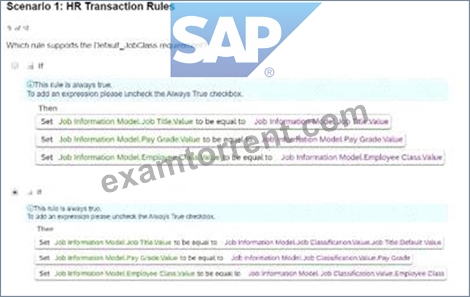
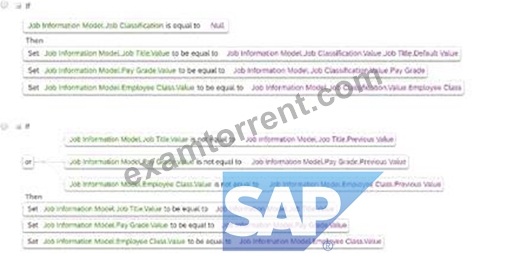
- A. Option B
- B. Option D
- C. Option A
- D. Option C
Answer: A
Explanation:
The rule in Option B supports the Default_JobClass requirement by setting default values for fields such as Job Title, Pay Grade, and Employee Class when the Job Classification field is NULL. This ensures that appropriate default data is applied to job information records when certain fields are not explicitly filled.
Scenario 1: HR Transaction Rules
NEW QUESTION # 43
Which of the following are examples of standard one-to-one associations?
Note: There are 2 correct answers to this question.
- A. Pay Range to Legal Entity
- B. Department to Division
- C. Location to Legal Entity
- D. Location to Geozone
Answer: A,D
NEW QUESTION # 44
Which of the following are possible options when working with SAP SuccessFactors Employee Central employee identifiers? Note: There are 3 correct answers to this question.
- A. A user can have only one user id.
- B. A user can have multiple user ids.
- C. Once generated, you CANNOT change a person id external.
- D. A user can have only one person id external.
- E. Once generated, you CANNOT change a user id.
Answer: B,D,E
Explanation:
In SAP SuccessFactors Employee Central, employee identifiers are managed as follows:
* A. Once generated, you CANNOT change a user id.
* The User ID serves as a unique identifier for an employee's employment record. Once assigned, it cannot be altered.
* D. A user can have multiple user ids.
* An employee may possess multiple User IDs, especially in scenarios involving concurrent employment or global assignments. Each employment instance is associated with a distinct User ID.
* E. A user can have only one person id external.
* The Person ID External uniquely identifies an individual across all employment records within the system. An employee is assigned a single Person ID External, regardless of the number of employments.
Options B and C are incorrect:
* B. A user can have only one user id.
* This is incorrect because, as mentioned, an employee can have multiple User IDs corresponding to different employment instances.
* C. Once generated, you CANNOT change a person id external.
* This is incorrect. While the Person ID External is intended to be a stable identifier, it can be changed if necessary, though such changes should be managed carefully to maintain data integrity.
NEW QUESTION # 45
How do you enable a cost center in the Succession Data Model to be used as a filter in a permission group?
- A. Go to <dg-filters> then add cost-center
- B. Go to <hris-field id="cost-center"> then add filter="true"
- C. Go to <hris-element="jobInfo"> then add dg-filter="true"
- D. Go to <custom-filters> then add cost-center
Answer: A
Explanation:
To enable a cost center in the Succession Data Model for use as a filter in a permission group, you must:
* Navigate to the <dg-filters> section within the Succession Data Model.
* Add an entry for the cost-center object within the <dg-filters> section.
This action allows the cost center to be selectable as a filter for Dynamic Groups, which are used to define permission groups in Employee Central.
NEW QUESTION # 46
Due to confidentiality reasons, when the HR Business Partner (maintained in Job Relationship) is creating a change in salary for an employee, this action will need to be approved by the manager of the HR Business Partner creating the request.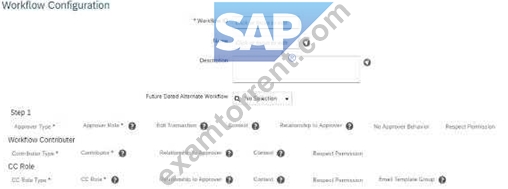
- A. By selecting in Step 1: Role - Manager - Source - Initiator
- B. By selecting in Step 1: Role - Employee HR - Source - Employee
- C. By selecting in Step 1: Role - Employee HR-Source- Initiator
- D. By selecting in Step 1: Role - Self-Source - Initiator
Answer: A
NEW QUESTION # 47
Due to confidentiality reasons, when the HR Business Partner (maintained in Job Relationship) is creating a change in salary for an employee, this action will need to be approved by the manager of the HR Business Partner creating the request.
How do you define this in the workflow when filling in the Approver Type, Approver Role, Context, and Relationship to Approver? Refer to the screenshot to answer the question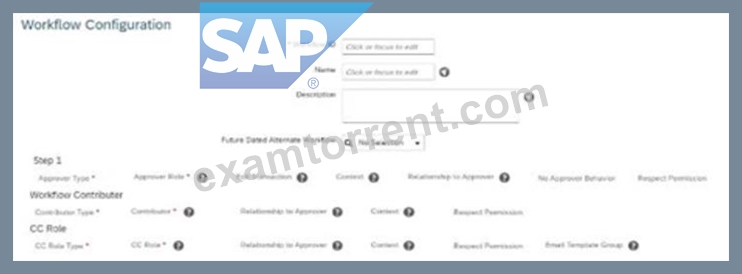
- A. By selecting in Step 1: Role - Manager - Source - Initiator
- B. By selecting in Step 1: Role - Employee HR - Source - Employee
- C. By selecting in Step 1: Role - Employee HR-Source- Initiator
- D. By selecting in Step 1:Role - Self-Source - Initiator
Answer: A
Explanation:
To ensure that the salary change initiated by the HR Business Partner is approved by their manager, you need to configure the workflow with the following details:
* Approver Type: Manager
* Approver Role: Manager
* Context: Initiator (this ensures the approval request is routed to the manager of the person initiating the workflow).
* Relationship to Approver: From the initiator's position, the system derives the relationship to their manager.
SelectingRole: Manager - Source: Initiatorin Step 1 aligns with these requirements.
Scenario 2: Approvals for Self-Service
NEW QUESTION # 48
Which permission controls a user's access to the Edit button in the history of Job Information?
- A. Job Information Actions > Correct
- B. Job Information Actions > View History
- C. Job Information Actions > Edit/Insert
- D. Edit Link > Edit/Insert
Answer: A
Explanation:
* Job Information Actions > Correct permission controls the Edit button in the Job Information history.
* This permission allows users to correct existing records without creating a new effective-dated record. It ensures that only authorized users can make retroactive changes to historical data.
Other permissions, such as Edit Link > Edit/Insert, Job Information Actions > Edit/Insert, or Job Information Actions > View History, do not directly control access to the Edit button in the history section.
NEW QUESTION # 49
How does the system connect the country-relevant Legal Entity fields to a country? Note: There are 2 correct answers to this question.
- A. By association, using the countryOfRegistration.code in the Condition
- B. By association, using the 3-letter ISO code of the country in the Destination Filter Criteria
- C. By association, using the 3-letter ISO code of the country in the Condition Values
- D. By association, using the countryOfRegistration.code in the Source Filter Criteria
Answer: A,B
NEW QUESTION # 50
Which rule can effectively catch all unspecified events in a transaction?
- A. Option B
- B. Option D
- C. Option A
- D. Option C
Answer: A
Explanation:
The rule inOption Beffectively captures all unspecified events in a transaction because:
* It sets theEvent Reason Valueto"Data Change" whenever the Event Reason Value isnull.
* This ensures that all unplanned or unspecified events are assigned a default action, which is crucial for maintaining data consistency and avoiding errors during transactions.
Scenario 1: HRTransaction Rules
NEW QUESTION # 51
When the manager updates the location of an employee, the HR admin must be the approver Note that the HR admin, manager, and HR Business Partner have access to change the location.
How do you create the IF condition for the workflow derivation rule lo meet the above requirements?
- A. Option B
- B. Option D
- C. Option C
- D. Option A
Answer: D
Explanation:
To meet the requirement where the HR admin must approve the manager's updates to an employee's location, the workflow derivation rule must include the following IF condition:
* Option A: Ensures that the condition checks whether the user belongs to the permission group for HR Admins, and the Event Reason value matches "Location Change".This configuration aligns the workflow rule with thescenario requirements, where HR admins are explicitly designated as approvers Scenario 2: Approvals for Self-Service
NEW QUESTION # 52
You need to create a one-to-many association from Location to Legal Entity. You also need to configure filtering of the Location field based on the Company field in the Job Information block.
What do you need to add to the data models?
Note: There are 2 correct answers to this question.
- A. <association> as part of <hris-element id="jobInfo">
- B. <association> as part of <hris-element id="location">
- C. <field-criteria> as part of <hris-field="location">
- D. <field-criteria> as part of <hris-field="company">
Answer: B,C
NEW QUESTION # 53
To which Job information field will you assign the Default_JobClass rule?
- A. Pay Grade
- B. Job Title
- C. Job Code
- D. Employee Class
Answer: C
Explanation:
The Default_JobClass rule should be assigned to the Job Code field in Job Information. This field serves as the key reference for deriving other job-related attributes, such as Job Title, Pay Grade, and Employee Class, ensuring that defaults are set when required.
Scenario 2: Approvals for Self-Service
NEW QUESTION # 54
How do you create country-specific fields for the Legal Entity object?
- A. As a generic object with a composite association to the Legal Entity object
- B. As an HRIS element in the Corporate Data Model with a composite association to the Legal Entity object
- C. As an HRIS element in the Country Specific Field for Corporate Data Model with a Valid When association to the Legal Entity object
- D. As a generic object with a Valid When association to the Legal Entity object
Answer: C
Explanation:
To create country-specific fields for the Legal Entity object in SAP SuccessFactors Employee Central, you should define these fields as an HRIS element within the Country-Specific Field section of the Corporate Data Model. This approach allows the system to manage country-specific attributes effectively. The 'Valid When' association is utilized to ensure that these fields are applicable only when certain conditions, such as the country of registration, are met. This configuration ensures that the Legal Entity object contains fields relevant to specific countries, facilitating accurate data management and compliance with local regulations.
NEW QUESTION # 55
What properties are available when using model base objects in business rules? Note: There are 3 correct answers to this question.
- A. PII
- B. Visibility
- C. Previous Value
- D. Max-length
- E. Required
Answer: B,C,E
NEW QUESTION # 56
......
C_THR81_2411 Free Study Guide! with New Questions: https://passleader.examtorrent.com/C_THR81_2411-prep4sure-dumps.html
