

Free RPFT Questions for NBRC RPFT Exam [Jan-2026]
Validate your RPFT Exam Preparation with RPFT Practice Test (Online & Offline)
The Registry Examination for Advanced Pulmonary Function Technologists (RPFT) is a certification exam offered by the National Board for Respiratory Care (NBRC). RPFT exam is designed for individuals who have completed advanced training in pulmonary function testing and wish to become certified in this field. The RPFT certification is highly respected and recognized in the healthcare industry, and is a requirement for many advanced pulmonary function technologist positions.
Passing the NBRC RPFT exam is a significant achievement for advanced pulmonary function technologists. It demonstrates that the candidate has the knowledge, skills, and expertise required to perform advanced pulmonary function testing and interpret the results accurately. Additionally, holding the NBRC RPFT certification can lead to higher salaries, increased job opportunities, and greater professional recognition within the respiratory care community. Overall, the NBRC RPFT exam is an essential step for respiratory therapists seeking to enhance their skills and advance their careers in this exciting and rapidly growing field.
NBRC RPFT (Registry Examination for Advanced Pulmonary Function Technologists) Exam is a certification exam for those who wish to become advanced pulmonary function technologists. RPFT exam assesses the knowledge and skills of individuals who work in the field of pulmonary function testing. RPFT exam is designed to ensure that candidates have the necessary skills to perform and interpret pulmonary function tests, as well as to evaluate and manage patients with respiratory diseases.
NEW QUESTION # 52
During a cardiopulmonary stress test using breath-by-breath gas analysis, a pulmonary function technologist notices that the VO2 suddenly decreases. Which of the following may explain this change?
1. The patient has achieved anaerobic threshold.
2. The measurement of the expired gas volumes is inaccurate.
3. O2 analyzer "phase delay" has increased.
4. There is a leak in the tubing or mouthpiece.
- A. 2, 3, and 4 only
- B. 1, 3, and 4 only
- C. 1, 2, and 3 only
- D. 1, 2, and 4 only
Answer: B
Explanation:
Explanation/Reference:
NEW QUESTION # 53
The following test results are available for a 35-year-old subject who is applying for disability:
These findings are consistent with
- A. Pulmonary fibrosis
- B. Occupational asthma
- C. A paralyzed hemidiaphragm
- D. Poor effort
Answer: C
NEW QUESTION # 54
Biological control data are obtained for lung volumes by plethysmography. The following results are obtained: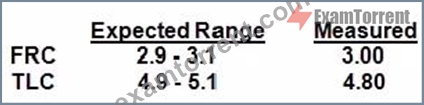
A pulmonary function technologist should repeat the test instructing the individual to
- A. Pant at 90 to 100 Hz
- B. Pant at 40 to 50 Hz
- C. Inhale to TLC
- D. Inhale to TV
Answer: C
NEW QUESTION # 55
A 9-year-old girl had an FVC of 2.35 L1 year ago. She was 122 cm (4 ft) tall and weighed 29.5 kg (65 lb).
Her current height is 127 cm (4 ft 2 in), and her weight is 34 kg (75 lb). The current FVC measurement is 2.20
L. The quality of both tests met ATS/ERS goals. A pulmonary function technologist should conclude the change is
- A. Not significant since it is within normal test variability.
- B. Significant since a decline is not expected.
- C. Significant since her weight has changed.
- D. Not significant since it is less than a 15% decrease.
Answer: B
NEW QUESTION # 56
A 45-year-old female with sarcoidosis has pulmonary function tests annually. The following data have been recorded: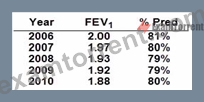
A pulmonary function technologist should conclude that
- A. The patient's restrictive component has worsened.
- B. The patient has a normal rate of loss for FEV1.
- C. The patient has developed mild obstructive airway disease.
- D. Incorrect predicted values have been used.
Answer: D
NEW QUESTION # 57
Which of the following thresholds for a clinically significant change in lung function from the beginning to the end of a methacholine challenge test is significant?
- A. A decline of more than 30% in FEF25-75%
- B. A decline of more than 20% in inspiratory capacity
- C. An increase of more than 20% in airway resistance
- D. A decline of more than 20% in FEV1
Answer: D
NEW QUESTION # 58
During an exercise study, a pulmonary function technologist notices the systolic blood pressure increased to
270 mm Hg using an automated cuff. Which of the following should the technologist do?
- A. Terminate the test at this time and recheck blood pressure.
- B. Continue the test if within 5 minutes of completion.
- C. Terminate the test and administer oxygen by nasal cannula.
- D. Continue the test and recheck blood pressure using manual cuff method.
Answer: C
NEW QUESTION # 59
The following biologic control data ranges were established:
The following additional data were obtained when assessing the equipment: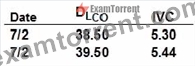
Which of the following should a pulmonary function technologist do?
- A. Check the flow sensor.
- B. Change the DLcoCO analyzer.
- C. Change the CO2and H2O absorbers.
- D. Continue testing patients.
Answer: A
NEW QUESTION # 60
A pulmonary function laboratory routinely tests five subjects as biologic controls. Acceptable instrument performance over time is indicated when measurements
- A. For an individual are within 2 standard deviations of the mean of those for the group.
- B. For each individual are within 2 standard deviations of the mean of previous measurements for each individual.
- C. Are within the 95% confidence interval predicted for an individual being tested.
- D. Of the group as a whole agree with those predicted by linear regression for changes in age.
Answer: C
NEW QUESTION # 61
Which of the following sets of FIF data is most consistent with an extrathoracic airway obstruction?
- A. Option D
- B. Option B
- C. Option A
- D. Option C
Answer: A
NEW QUESTION # 62
The following values are reported at maximum effort for a 50-year-old, 70-kg (154-lb) male with significant coronary artery disease during ergometer stress testing. Which of the following is most likely an error?
- A. workload 200 watts
- B. VE65L/min
- C. HR145/min
- D. RER1.2
Answer: A
NEW QUESTION # 63
A 54-year-old male with a normal ECG at rest develops dyspnea during an exercise (stress) test, and the following ECG pattern is noted at 25 watts: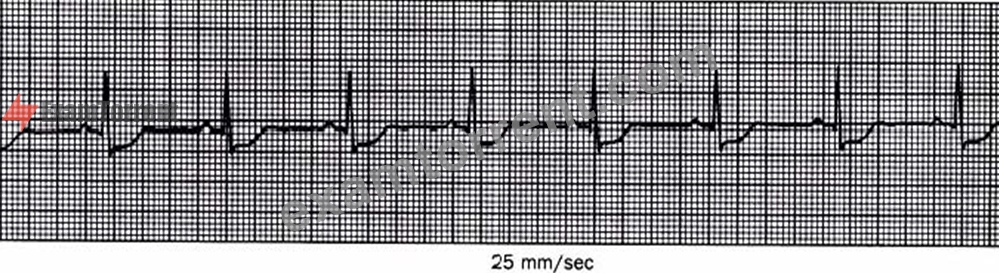
25 mm/sec A pulmonary function technologist should
- A. Continue the test and obtain an arterial blood sample.
- B. Stop the test immediately; there is evidence of ischemia.
- C. Continue the test until the subject reaches target heart rate.
- D. Stop the test immediately; there is evidence of heart block.
Answer: D
NEW QUESTION # 64
A 54-year-old male with a normal ECG at rest develops dyspnea during an exercise (stress) test, and the following ECG pattern is noted at 25 watts: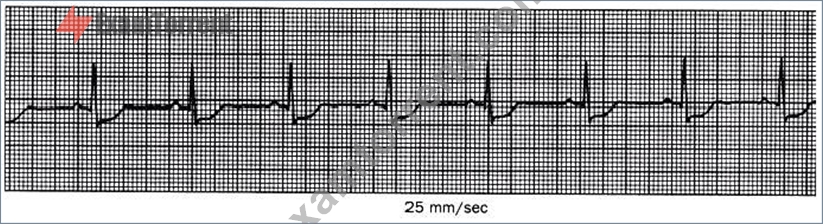
25 mm/sec A pulmonary function technologist should
- A. Continue the test and obtain an arterial blood sample.
- B. Stop the test immediately; there is evidence of ischemia.
- C. Continue the test until the subject reaches target heart rate.
- D. Stop the test immediately; there is evidence of heart block.
Answer: D
NEW QUESTION # 65
A body plethysmograph box pressure transducer fails the electronic calibration check after multiple attempts.
Which of the following should a pulmonary function technologist do?
1. Perform a biologic control test
2. Inspect the door seal.
3. Re-zero the box pressure transducer.
4. Perform a physical pressure calibration.
- A. 1, 2, and 3 only
- B. 2, 3, and 4 only
- C. 1, 2, and 4 only
- D. 1, 3, and 4 only
Answer: A
NEW QUESTION # 66
An isothermal lung analog has the following specifications:
5-L glass bottle
2000 g of steel wool
Density of steel wool 5 g/cm3
Volume of connectors and bulb 100 mi-Repeated FRC measurements in the plethysmograph result in a volume of 5.5 L.
Which of the following should a pulmonary function technologist do?
- A. Recalculate the BTPS correction
- B. Begin a biologic control program
- C. Remove 500 g of steel wool from the lung analog
- D. Take the plethysmograph out of service
Answer: B
NEW QUESTION # 67
A pulmonary function technologist is performing an exercise (stress) test on a patient with severe COPD. As the test progresses, the patient shows signs of increasing dyspnea. Measurements of inspiratory capacity decreased from 2.0 L to 1.5 L.
Which of the following most likely occurred?
- A. dynamic hyperinflation
- B. acute decrease in FRC
- C. drift in the flow transducer
- D. disconnected gas sampling line
Answer: B
NEW QUESTION # 68
A patient has normal pulmonary and cardiac function. Which of the following is most likely when the patient reaches the anaerobic threshold during incremental stress testing?
- A. Increased VDA/VTratio
- B. Decreased VE
- C. Decreased CO2production
- D. Increased RER
Answer: A
NEW QUESTION # 69
Which of the following is a common reason for an unstable zero reading from an infrared analyzer?
- A. Inaccurate calibration gases
- B. Exhausted DRIERITE
- C. Excess room humidity
- D. Debris in the sampling system
Answer: D
NEW QUESTION # 70
In setting up a CO analyzer, a pulmonary function technologist notices that the analyzer reads -0.03 while sampling air. The technologist should
- A. Adjust the reading to 0.00.
- B. Adjust the reading to +0.03.
- C. Reverse the sample flow.
- D. Accept the reading because it is within ± 3%.
Answer: A
NEW QUESTION # 71
......
Check Real NBRC RPFT Exam Question for Free (2026): https://passleader.examtorrent.com/RPFT-prep4sure-dumps.html
