


The sooner your study materials arrive, the sooner real work begins. ExamTorrent delivers the Microsoft Implementing Data Models and Reports with Microsoft SQL Server package by email within 1 minute of payment — 186 practice questions in PDF, desktop, and online formats, ready immediately.
Microsoft 070-466 Exam Syllabus Topics:
| Section | Objectives |
|---|---|
| Designing and Implementing Data Models | - Design and implement data warehouses - Design multidimensional database solutions - Design tabular data models |
| Data Integration and Management | - Manage data quality and consistency - Implement ETL solutions using SQL Server Integration Services (SSIS) |
| Implementing Reports and Dashboards | - Create and manage report models - Design dashboards and KPIs - Develop reports using SQL Server Reporting Services (SSRS) |
| Implementing Business Intelligence Solutions | - Develop OLAP cubes using SQL Server Analysis Services (SSAS) - Optimize BI performance and processing - Implement calculations using MDX and DAX |
070-466 Exam FAQ: Focused Prep, Real Support
The Microsoft Implementing Data Models and Reports with Microsoft SQL Server exam contains 40-60 to complete within 120-150. Timed simulation in the ExamTorrent Desktop Test Engine teaches that rhythm before exam day does.
Computer-based exam at authorized test centers or online proctored delivery (availability depends on region and provider) Register for the Microsoft Implementing Data Models and Reports with Microsoft SQL Server exam through these official channels:
After booking, ExamTorrent delivers your practice questions within 1 minute — preparation starts the same day.
ExamTorrent issues a full refund if you take the Microsoft Implementing Data Models and Reports with Microsoft SQL Server exam within 60 days of purchase and do not pass. The policy does not apply if the exam is taken within 3 days of purchase, if the exam was never actually taken, or to free materials or expired orders, and the candidate name must match the payer name. Submit a scan of your enrollment slip and the official Score Report PDF within 2 days of the exam; claims are processed within 7 days. Alternatively, exchange for two free exam products of equal value and keep your original update service. Orders arrive by email within 1 minute — contact support if nothing arrives within 2 hours.
The 070-466 exam is a Microsoft certification exam validating the Microsoft Implementing Data Models and Reports with Microsoft SQL Server syllabus shown above. It belongs to these credential paths: MCSE: Data Platform, MCSA: SQL Server. Candidates in 2026 start with ExamTorrent's 186 practice questions, available as a printable PDF, a Windows Desktop Test Engine, and an Online Test Engine — three versions of the same materials.
The official Microsoft Implementing Data Models and Reports with Microsoft SQL Server outline defines 4 domains. The leading three are Implementing Business Intelligence Solutions, Data Integration and Management, and Implementing Reports and Dashboards. The full list is in the topics section above, and ExamTorrent's 186 practice questions cover each one.
Recommended experience with SQL Server, data warehousing concepts, and BI tools such as SSRS, SSAS, and SSIS. Since requirements change over time, confirm the latest on the official Microsoft exam page before scheduling.
Microsoft recommends these training resources for the Microsoft Implementing Data Models and Reports with Microsoft SQL Server exam:
Follow the training with steady self-testing — the 186 practice questions from ExamTorrent help you apply theory and fill any gaps the training leaves.
The Microsoft Implementing Data Models and Reports with Microsoft SQL Server exam requires 700 (on a 1000 scale) to pass, and registration costs USD 165 (may vary by country). A failed attempt means paying the same fee again — a readiness check with the ExamTorrent engines before booking is the cheaper option.
Three versions of the same study materials: a printable, expert-prepared PDF with free demo download and instant access; a Desktop Test Engine for Windows with customizable simulation and timed modes that works offline; and an Online Test Engine for any browser on Windows, Mac, Android, and iOS with test history and performance review. All 186 practice questions are identical across versions. Every purchase includes 365 days of free updates, a 50% renewal discount afterward, and unlimited computer installations.
Microsoft Implementing Data Models and Reports with Microsoft SQL Server Sample Questions:
You are creating a new report in SQL Server Report Builder. You add a Microsoft Azure SQL Database data source. Then you add a dataset that has four fields named Year, Country, Category, and Sales.
You must design a matrix as shown in the following table.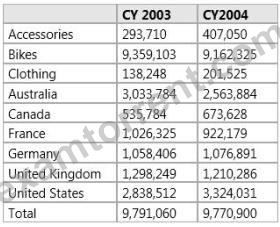
The category rows (the first three rows as shown in the diagram) must present total sales amount by category. The country rows {the next six rows as shown in the diagram) must present total sales amount by country. The total row must present the total sales for each year.
You add a matrix to the report. You add a grouping of the Category field on the rows and a grouping of the Year field on the columns.
You need to add the countries on the rows of the matrix.
Which Row Group option should you select when you add the group?
- A. Adjacent Above
- B. Child Group
- C. Adjacent Below
- D. Parent Group
Correct Answer: C 🗳️
You are developing a BI Semantic Model (BISM) that retrieves data from several sources including a Microsoft Azure SQL Database database and an OData data feed. The model will be deployed to a server with significantly more memory than the total size of the source data.
You have the data feed URL, which you will use when developing the model in SQL Server Data Tools (SSDT).
The model must meet the following requirements:
*Maximize performance
*Data latency of up to one month is acceptable
You need to choose a project type and a data access mode to meet the requirements.
What should you do?
- A. Select the tabular project type and use the In-Memory query mode.
- B. Select the tabular project type and use the DirectQuery query mode.
- C. Select the multidimensional project type and use the MOLAP storage mode.
- D. Select the multidimensional project type and use the ROLAP storage mode.
Correct Answer: A 🗳️
You are modifying a SQL Server Analysis Services (SSAS) cube that aggregates mobile phone usage data from a Microsoft Azure SQL Database database. The existing database contains a device dimension.
The Research and Development team has requested that capabilities be added to the database.
The capabilities must meet the following requirements:
*A device member must be able to have multiple capability members.
*A capability member must be able to belong to several device members.
*The Research and Development team must be able to create new capabilities every quarter in the data source.
You need to implement the appropriate solution to meet the requirements while ensuring that the amount of development and maintenance time is minimized.
What should you do? (More than one answer choice may achieve the goal. Select the BEST answer.)
- A. Add an attribute hierarchy for each capability to the customer dimension. Configure each hierarchy to have two members named Yes and No.
- B. Create a dimension named Capability Name and then configure a many-to-many relationship.
- C. Add an attribute hierarchy named Capability Name to the customer dimension.
- D. Create a dimension named Capability Name and then configure a regular relationship.
Correct Answer: B 🗳️
You maintain a multidimensional Business Intelligence Semantic Model (BISM) that was developed with default settings.
The model has one cube and the cube has one measure group. The measure group is based on a very large fact table and is partitioned by month. The fact table is incrementally loaded each day with approximately 800,000 new rows.
You need to ensure that all rows are available in the cube while minimizing the processing time.
Which processing option should you use?
- A. Process Index
- B. Process Default
- C. Process Clear
- D. Process Data
- E. Process Full
- F. Process Add
Correct Answer: F 🗳️
You need to create the KPI in the AdhocReports project in time for the next production release cycle.
What should you do?
- A. Create a measure by using the SUM([OrderQuantity]) expression and create a KPI based on the measure. Then set the target value. Check in the changes before the next release cycle.
- B. Create a measure by using the COUNT([OrderQuantity]) expression and create a KPI based on the measure. Then set the target value. Check in the changes before the next release cycle.
- C. Create a KPI based on the OrderQuantity column and then set the target value. Check in the changes before the next release cycle.
- D. Create a measure by using the SUM((OrderQuantity]) expression. Then use the CREATE KPI CURRENTCUBE statement to define the KPI and target value. Check in the changes before the next release cycle.
Correct Answer: D 🗳️
Viewing page 1 out of 38 pages.
Viewing questions 1-5 out of 186 questions.


 930 Customer Reviews


